

Why Hypothyroid Persists Even When Blood Tests Are “Normal” (Part 3/7)
Low Stomach Acid in Hashimoto’s: The Pattern We Keep Missing
When we think of Hashimoto’s thyroiditis, we tend to focus on numbers -TSH, T3, T4, antibodies, dose adjustments. But in clinical practice, a different story keeps repeating itself. A patient walks in with fatigue, bloating, hair fall, and stubborn deficiencies. They’ve already tried iron, B12, probiotics, elimination diets - often multiple protocols layered one over the other. And yet, nothing quite translates. Somewhere in that story sits a quiet, overlooked pattern: low stomach acid.
It rarely presents itself clearly. Instead, it disguises itself as the opposite problem. Patients describe acidity, reflux, and heaviness after meals, leading to the assumption of excess acid. Acid gets suppressed, symptoms temporarily ease, but the deeper pattern continues to build. Because what appears to be too much acid is often too little acid in the wrong context. Food lingers longer than it should, protein digestion becomes inefficient, and early fermentation begins. Gas builds, pressure rises, and the body pushes upward. It feels like acidity, but the root is insufficiency.
Over time, this begins to affect nutrient status. Iron doesn’t absorb well despite consistent supplementation. B12 levels remain low or require repeated support. Hair begins to thin, nails lose strength, and energy does not reflect the quality of diet. The question becomes - how can someone eat well and still feel undernourished? Because digestion is not just about intake; it is about what is unlocked. And stomach acid is where that process begins.
This pattern extends into thyroid function itself. Medication may be taken regularly, and lab values may appear acceptable, but the person still does not feel better. Energy fluctuates, recovery is delayed, and there is a sense that the body is not utilising what it is being given. Without proper protein breakdown and amino acid availability, thyroid hormone function at the cellular level remains incomplete. It is not always a dose issue; sometimes, it is a digestion issue presenting as a thyroid problem.
As stomach acid remains low, the gut environment begins to shift. One of the body’s primary defence barriers weakens. Microbes that should have been neutralised begin to persist and overgrow. This often evolves into patterns like Small Intestinal Bacterial Overgrowth. Food sensitivities increase, bloating becomes unpredictable, and the gut feels reactive rather than resilient. The response is usually to add more - more probiotics, more antimicrobials, more dietary restriction. But the terrain that allowed the imbalance remains unchanged.
This is where many approaches lose direction. Each symptom is addressed individually- iron for anemia, B12 for fatigue, probiotics for bloating, thyroid medication for hormones. But the pattern connecting them is missed. The patient is not failing treatment; the treatment is missing sequence. Physiology does not respond well to scattered interventions. It responds to order.
Stomach acid is more than a digestive fluid. It is a signal of readiness, a marker that the body is in a state where it can process, absorb, and utilise. When it is low, it often reflects a system that is conserving energy, downregulating function, and prioritising survival over optimisation. Until this shifts, adding more inputs rarely changes outcome.
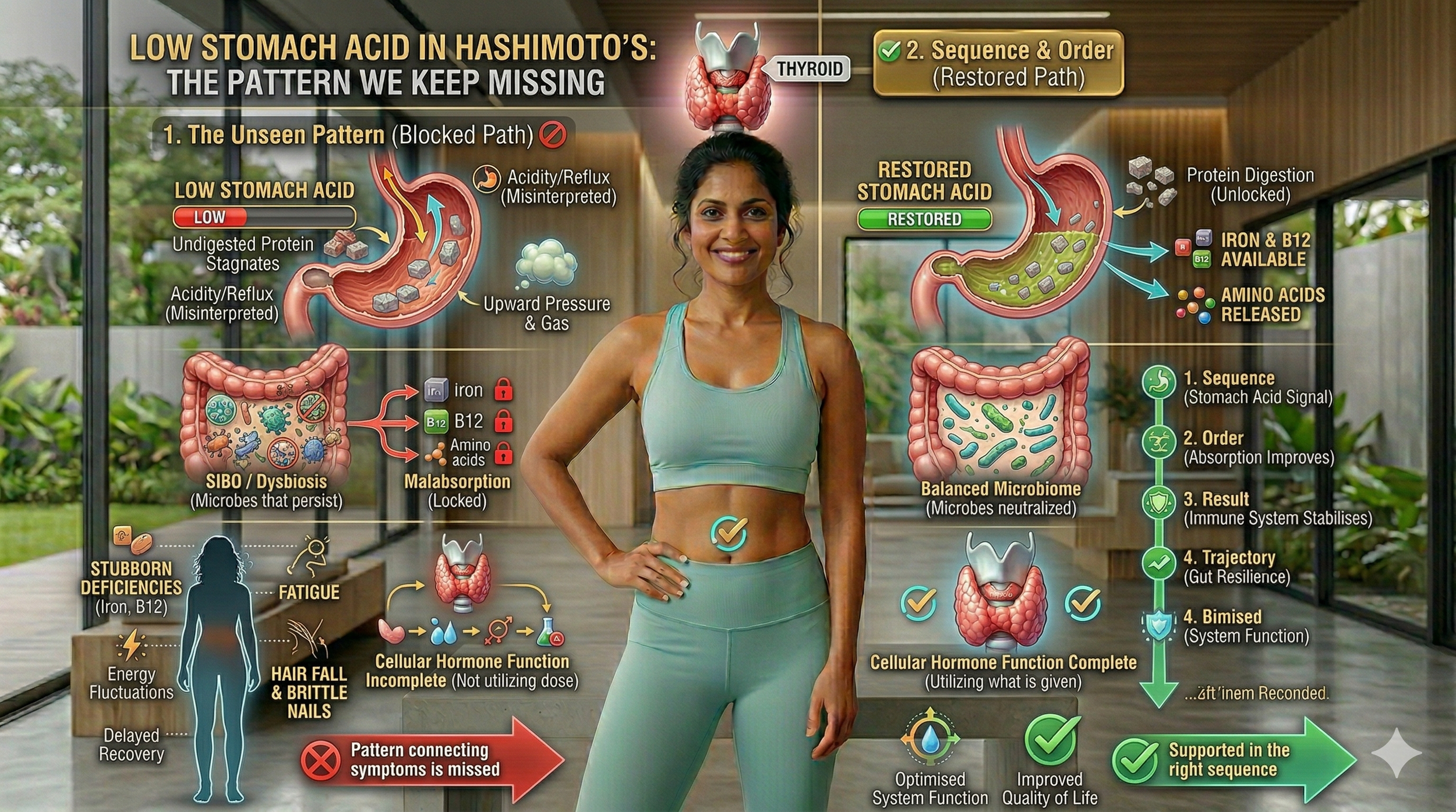
The turning point comes not from doing more, but from seeing clearly. When low stomach acid is recognised as the underlying pattern, the direction changes. Digestion improves, absorption improves, the immune system stabilises, and the gut begins to follow. Not because more was added, but because the body was finally supported in the right sequence.
This is the work that often goes unnoticed. Precise and foundational. But in many cases of Hashimoto’s, it is the difference between managing symptoms and actually changing the trajectory.
